

The following is an excerpt from my book Big Wild Life.
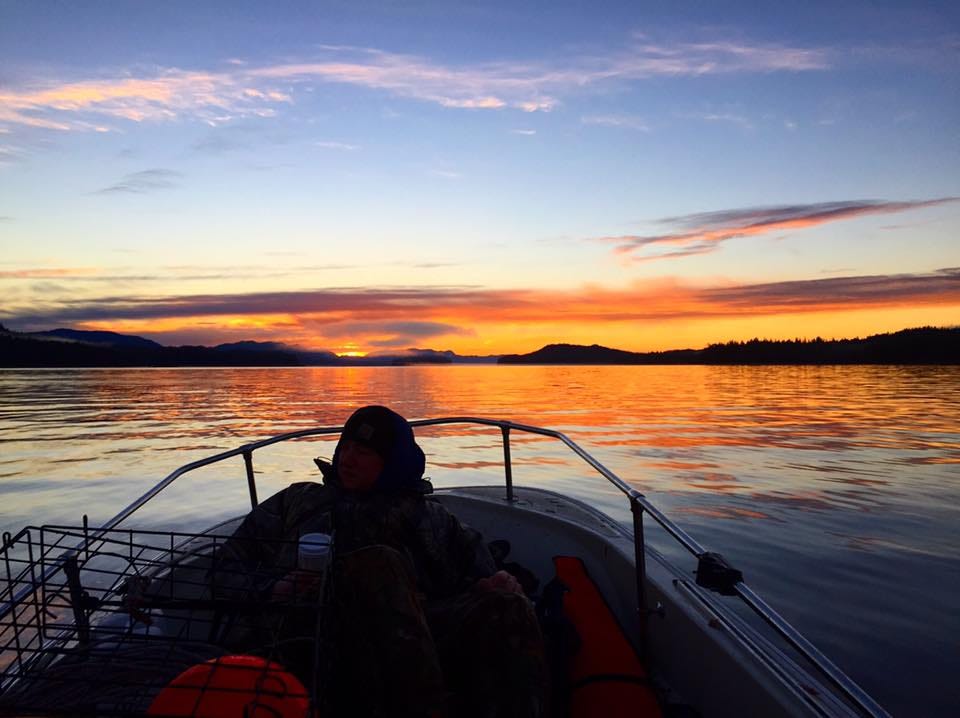
My seventeen-minute commute to work at Ketchikan High School starts with a brief view of the ocean through a cluster of towering spruce. In a few months, the water will be busy with trollers, locals, and the first nonresident anglers fishing the only open king salmon fishery in the area. It’s a fairly protected drag, but the most common wind direction is southeast. From the spot through which I can see the rising sun paint the underside of the morning clouds orange, I can also expect brutal winds kicking up four-foot waves when the tide and wind conspire against anyone hoping to enjoy their quest for fish.
The waters surrounding Ketchikan are considered “inside waters” since, in addition to smaller islands, Prince of Wales Island creates a buffer between the brutality of the Gulf of Alaska and the straits, inlets, coves, arms, and bays around Ketchikan. Heading southeast from the boat launch nearest home, it’s roughly four miles to Bold Island, which is centered nicely between Revillagigedo and Annette Island and breaks the building waves born on wind and tide. After Bold, the islands are more distant, and the ocean has more space to build. Another nine miles and it’s a straight shot south to Dixon Entrance. On a day in which the waves are four feet near the launch, they’ll be at least triple that at Dixon. Islands to the south are now Canadian, and a simple turn west allows a view of nothing but ocean until Asia. The visible islands to the north and south only funnel the ocean’s rage.
From late spring until early fall, it’s easy to get motivated to launch the skiff thanks to the plethora of fishing and hunting opportunities. Winter is a different story. The more calm the water and clear the sky, the more likely the wind is out of the north, which drops temperatures and makes open-skiff rides face-numbingly cold. The cloudy and calm days between weather changes can be deceitful. Combine the fickle weather with close to eighteen hours of darkness, and it’s pretty easy to get into a routine of driving to work in the dark, driving home in the dark, and settling in for dinner at 4:30 p.m. Sometimes good weather lands on a weekend, but it can still be a struggle to get motivated to get out. Weather windows turn to sucker holes, and even sophisticated weather models miss. I know I should sound braver, as this sort of apathetic talk goes against the widely accepted ethos of Alaska living, but the truth is, it’s hard, particularly if your personal philosophy is more risk-averse than full send. It’s not that stories scare you into inactivity, but you ignore potential lessons at your peril.
In February of 1979, Elmo Wortman, his son Randy (16), and daughters Cindy (17) and Jena (13) were returning to Craig, on the west side of Prince of Wales, from a visit to Prince Rupert, a port city on the coast of British Columbia a few hours south of Ketchikan. They had made the Dixon Entrance crossing nearly a dozen times in their thirty-three-foot sailboat, but the family encountered a storm that paid no mind to meteorological predictions. At night, each had a one-hour stint at the tiller, then two hours off. This was before GPS, when navigation was done by landmarks, compass, sextant, and dead reckoning. With the weather punishing the boat, it was difficult to get an accurate location from the radio direction finder, which utilized low frequency radio waves, so Elmo had to assume their location. Their only communication was a CB radio that had limited range, and without radar, they were at the mercy of the weather. Without an emergency position-indicating radio beacon (EPIRB).
Modern navigation and safety on the ocean has its roots, not surprisingly, in the military. The LORAN navigation system was put into use during World War II. It allowed a receiver to determine position by listening to low frequency radio signals transmitted by fixed radio beacons on land. By listening to the radio frequencies, the system could triangulate a position. Successful iterations, particularly LORAN-C, improved the technology but eventually became obsolete after GPS was made available to the public. The advancement and marriage of technologies have made safety and rescue even more efficient. The early EPIRB devices sent signals that were picked up by satellites but would take time to fix a location. Today’s EPIRB activation sends out a GPS location immediately.
Moments before the boat crashed onto the rocks, the Wortman family grabbed what supplies they could, freed their Sportyak (a stable, durable craft meant for tendering between boat and shore more than a survival vessel) and attempted to make shore. They did, and thus began a monthlong battle for survival along the east side of Dall Island, west of Prince of Wales. Knowing there was a cabin in an inlet north of their location, they attempted a twenty-five-mile journey along the shore but eventually split. Leaving the girls in a shelter, Elmo and Randy set off ahead for the cabin, hoping to use the CB radio to call for help, but frostbite made both nearly immobile, and they were unable to leave the cabin. At one point they cut dead and infected skin from their own feet to keep the infection from spreading. The girls ended up being on their own for nearly two weeks but survived using part of the sail as a shelter and foraging for food. During a break in the weather, Elmo and Randy left a note at the cabin and set off toward the girls in a damaged skiff, expecting to find their bodies. While they were gone, the owner of the cabin returned, found the note, and called the Coast Guard. All four survived.
My parents taught in Craig, so we were familiar with the story even though it happened two years before I was born and seven years before we moved to Alaska. While there was always the possibility of a disaster at sea, growing up where the ocean was such an important part of life, there wasn’t a constant fear for locals with boats or commercial fishermen. There was a simple acceptance of reality but also the underlying satisfaction that came from being part of such a gloriously lucrative but dangerous industry. Every few years we’d hear about a boat going down, and the communities most affected would draw close in the way small, isolated communities do when tragedy hits. The Southeast Alaska community at large would also join in the collective mourning.
By the time I was in high school, I was aware of the reality of commercial fishing and knew it wasn’t for me. I spent the summers in Colorado visiting family and going to a summer camp. My parents didn’t want me to be intimidated by the big world after high school, so that was their way of exposing me to the Lower 48. When I was of working age, I flung pizzas and tended to salmon fry at the fish hatchery on the Klawock River, one of the only salmon hatcheries in Alaska that is located on a river with a native salmon run. After seeing the disaster of hatcheries in California, Oregon, and Washington, the Alaska Department of Fish and Game created a salmon enhancement program that would have hatchery fish returning to small creeks with no spawning grounds. Returning fish circle, or push up with the tide, but cannot spawn and become an important resource for personal use or for sport and commercial fisheries. So my job was indirectly related to commercial fishing, but outside of driving a 1970s Boston Whaler from the dock to the net pens on Klawock Lake, I never boarded a boat to actually fish commercially. Friends and acquaintances made money, sometimes great money, but the job was brutal and dangerous.
I was a junior in high school when seventy-foot waves sank the seventy-seven-foot long-liner La Conte in the vicinity of Sitka and read about it in the newspapers. A US Coast Guard H-60 Jayhawk helicopter followed the EPIRB signal and attempted to start collecting survivors, but the weather was so poor the basket could only be lowered to thirty feet above the water’s surface. After several tries, the helicopter had to return to the base for more fuel. With no life raft, the crew struggled to stay together and survive in the cold ocean.
A second helicopter was deployed from the base in Sitka and arrived on-site after midnight, five hours after the sinking. The crew managed to put on survival suits before the boat sank which would delay hypothermia substantially, but not indefinitely. The hurricane force winds made it nearly impossible to put the rescue basket exactly where it needed to be, and the survivors couldn’t swim to split the difference. At one point the pilot had to pull up to prevent a wave from striking the helicopter itself, and the cable that was connected to the basket began to fray. Skill and luck finally placed the basket in the right place and survivors were plucked from the sea. The La Conte’s captain, Mark Morley, was hanging from the side of the basket and was beaten against the underside of the helicopter as the rescuer attempted to pull the basket in the door, not knowing it was Morley who was preventing the basket from entering the helicopter. Morley fell. The basket was lowered close enough to touch him, but he was motionless. Low on fuel, the Jayhawk made its way to Yakutat, a shorter distance than Sitka.
Of the five crew on board, three survived. The next day, Morley’s body was recovered ten miles from where the La Conte sank. Six months later, the remains of crewman David Hanlon were found by hunters 650 miles away on Shuyak Island, just north of Afognak Island, near Kodiak.
Catastrophes are part of life but not a daily occurrence, so Alaskans don’t live with a perpetual feeling of doom. Most Alaskan communities cope with winter in the local gym where residents gather to support the high school basketball team. Commercial travel is done with much more discretion, and for every white-knuckle flight with my teammates, there were probably three or four cancellations or delays due to weather. The same month as the harrowing rescue attempt of the La Conte, we were shuttled from Kake to Angoon in a pair of de Havilland Beavers—the ubiquitous, if not iconic, Southeast Alaska floatplane—for a four-game basketball road trip. Brothers were separated just in case, but there wasn’t a real fear for our lives. The bush pilots who make jokes with tourists and nonresident hunters and anglers earn their stripes during winter. We know they’re good. We trust they’re good. But no one welcomes stiff winds when we’re traveling by floatplane, no matter how good the pilots are.
When I moved back to Alaska in 2013 after ten years of teaching and coaching in California, I immediately wanted to get involved with the high school basketball team. I took a job teaching at Ketchikan High School, a larger school that played against teams in cities big enough to have Alaska Airlines service. No more floatplanes to play hoops! As much as my love for basketball motivated me to get back on the bench, it really is an effective way to pass the cold, dark, stormy months of winter.
Powerful storytelling on the Wortman survival. The detail about cutting dead skin from their own feet to stop infection is harrowing, but what gets me is how you connect emergency tech evolution (LORAN to GPS to modern EPIRB) back to those monthly struggles. I grew up around commercial fishing in the Pac Northwest, and the risk calculus changes so much once communication becomes instant instead of hoping someone finds a note in a cabin.