

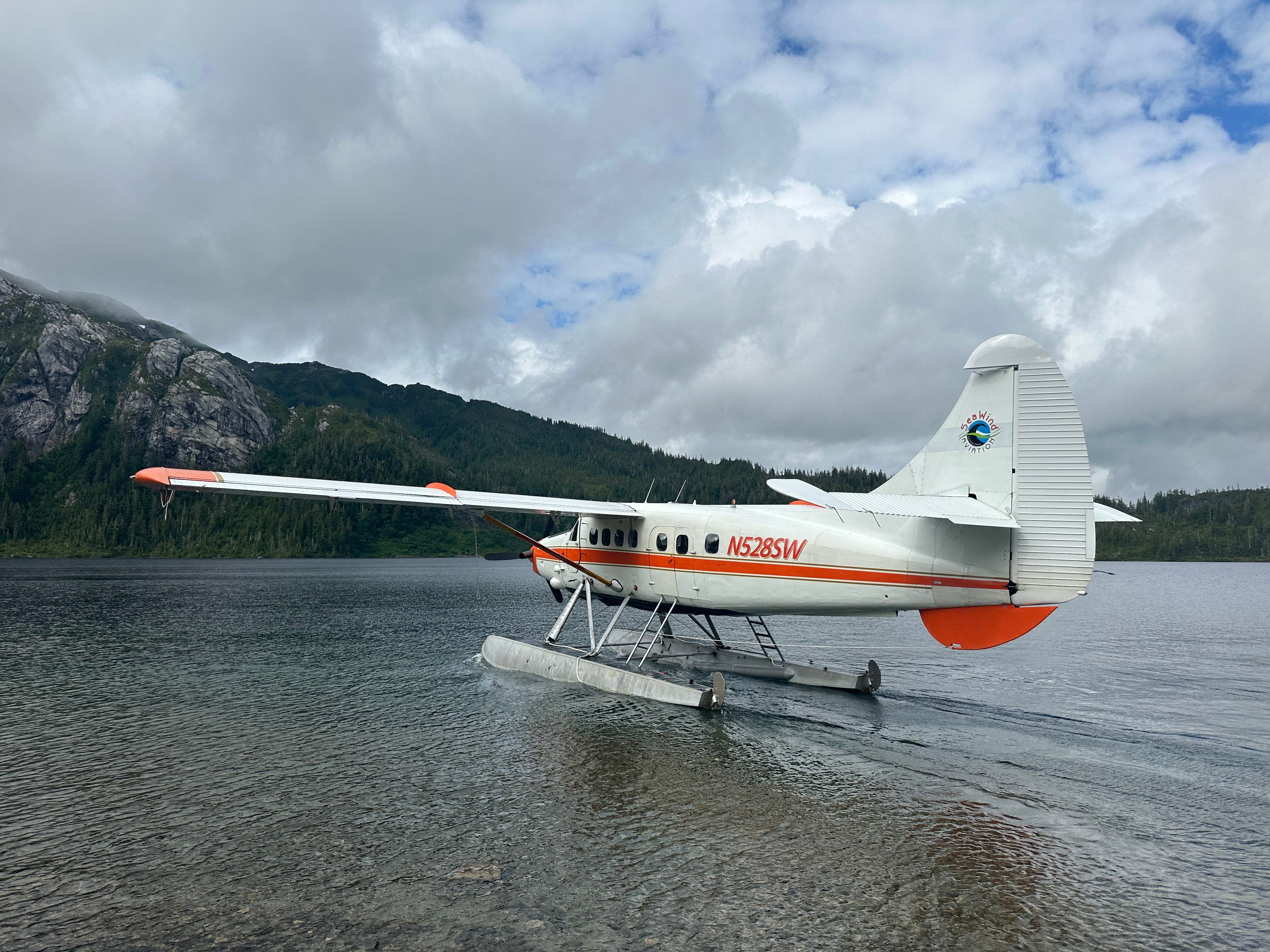
For all the noise, the de Havilland Otter seems to struggle at first before rugged power creates undeniable inertia. It’s more of an All-Pro edge rusher than wide receiver.
The whine is deeper and more powerful than its Beaver counterpart, but it’s still almost surprising the Otter is able to clear the choppy water and get airborne in such a short distance. On the Alaska Airlines jets that blast down the runway at over 180 miles per hour headed to points north or south, you feel the nose come up, first class gets airborne first and eventually you’re all shooting skyward at a 10-15-degree angle.
You bounce a little bit in the Otter, then you bounce no more. You’re up. How? You might pull a G in the jet to Seattle, in an Otter, the water just leaves you as you float skyward once free from the drag of the water and cruise at over 100 miles per hour toward your destination.
It’s still intimate and thrilling even though more than thirty years have passed since my first flight in a floatplane. On this trip I’m headed to a lake I scouted for the blacktail deer opener with my nephew and brother. Our pilot is a born-and-raised Ketchikan local Steve Kamm, the founder and owner of Seawind Aviation.
“Can you get into this one?” I asked, pointing to a lake on a map days before our fly out.
“You can get into anything. It’s just getting out of it that can be tough.”
Starting out
Steve Kamm has the quiet, honest confidence of an experienced pilot. He flies according to what he knows the plane can do and doesn’t use experience as an excuse to push the limits. He’s heart, head and just enough guts. Not ego.
After meeting him, stepping up into the fuselage, and strapping in, you have a second to assess your confidence in the situation. “Yeah, we’re good.”
I know Steve mostly from parent-teacher conferences when I discussed (all good things) the classroom performance of his three daughters, all of whom I had in my English or Journalism classes over the last decade. Flashback a little further when Steve was early in his career as a commercial pilot while I was traveling around the Prince of Wales Island and Ketchikan areas for cross country meets and basketball games as a high school kid.
“You probably flew with me a bunch of times.”
“Probably.”
There might be a reputation for people who live in the same town in which they were raised, but Steve wasn’t afraid to get out. He came back by choice, which is what he recommends.
“Seattle was fun for a while, but I could kind of see real quick that it just got… it wasn’t me. Even now when I go to the big cities, it doesn’t get me going.”
Steve’s great-grandfather started E.C. Phillips and Son, a lucrative fish processing plant, in 1950 that is now located just down the road from the dock where he keeps his planes. His father became a commercial pilot and gently encouraged Steve but didn’t want to apply pressure to fly though from a young age Steve was taken by aviation. His father was adamant that he stay away from commercial fish processing and industrial logging.
“My dad said, ‘If you work for the family, I’ll break your neck’ and then he said, ‘and if you work for the pulp mill, I’ll break both your legs.’ And my dad’s not a violent guy… he just said, ‘I don’t want to see you end up at those two places’.”
The Ketchikan Pulp Mill operated from 1954 to 1997 and employed over 500 full-time workers though the financial impact was significant not only to Ketchikan, but the surrounding areas. Steve stayed clear of the mill, choosing throttles and floats rather than logs and timer fiber separation.
By the time the mill closed, Steve had hundreds of hours in the air and Ketchikan had started to transition its identity to tourism.
Flightseeing
While flying out hunters and anglers takes him to interesting places, flightseeing trips is what makes up the lion’s share of the business.
Steve didn’t know the hours off the top of his head, but he knew he did 179 tours in the summer of 2024 and did seven trips to Misty Fjords in one day. That’s the big ticket item. The Mistys, as they are locally known, are impossibly majestic, glacial-carved fjords a short flight southeast of town. The walls rise from sea level to over 3000 feet in three-quarters of a mile. Think Yosemite’s El Capitan rising up out of the ocean. Boats can nose up to waterfalls and touch the rock wall while the transducer reports the depth to be 200 feet.
The fjords are cut into the mainland and encompass 2.3 million acres, slightly larger than Yellowstone, of nearly untouched landscape. There are no road access, no large scale mining and the terrain is so extreme whatever was able to be logged was done before it became a National Monument in 1978 and was given Wilderness status in 1980.
But Southeast Alaska is notorious for bad weather, especially Ketchikan which averages around 150 inches of rain per year.
“Some days the weather doesn’t work out, so it’s kind of like, ‘Okay, look out the window, it’s pretty outside. Listen to Led Zeppelin and let’s go’.”
He has no plans to retire but is on the mentoring side of the profession.
“There’s no need for macho in this,” he tells his pilots. “There’s no need to prove it.”
Fly outs
Steve adjusts course after takeoff and we’re off in the straightest line possible to get to the lake. It’s beautiful and clear, the type of day that typically brings a stiff wind from the north, but it’s a breath.
Southeast Alaska has myriad lakes with access to the alpine but that doesn’t mean it’s easy to get away from people. Similar to areas in Interior Alaska having limited strips for remote drop offs, there are only so many lakes that allow for both drop off and the non-negotiable second half of the trip–the take off.
He’s had his share of hunters he can’t retrieve during fly outs due to localized weather.
“You can get stuck or lose time going out. Just be patient.”
But he feels for the hunters knowing the trip might be a once-in-a-lifetime opportunity.
“Sometimes you just carry the stress of wanting to get them out there and make sure they get deer and have a good experience.”
Surprisingly the lake I chose was one Steve had never been to, which wasn’t encouraging. Maybe everyone else knew something I didn’t, which happens often, but the lake was also further than his typical fly outs.
It’s a straightforward flight plan. Visibility is endless and the lake isn’t tricky. I look down through the trees and spot bedded deer as we approach. One...two…three.four.five. It seems like we’re traveling fast now as we approach the water. The weight of the Otter makes the craft settle into the lake rather than hit it.
Steve whips the plane around and tries to get us as close to the shore as possible and says he’ll see us in a few days. He taxis a short distance then accelerates and the Otter is up. The deep drone echoes off the surrounding peaks then fades.
We set up camp on the shore and I use the spotting scope to put eyes on tan dots that stand out in contrast to the grey rock and green alpine heather. It’s going to be a great hunt.
An hour later the whine of a Beaver brings me out of the tent. It’s another local company that lands and drops off two hunters four hundred yards down the shore cutting our hunting acreage in half.
I’m irritated, but it’s a public lake and there are plenty of deer.